Explosive SpaceX Nasdaq IPO: Stock Soars 19% in Historic $2.1 Trillion Debut
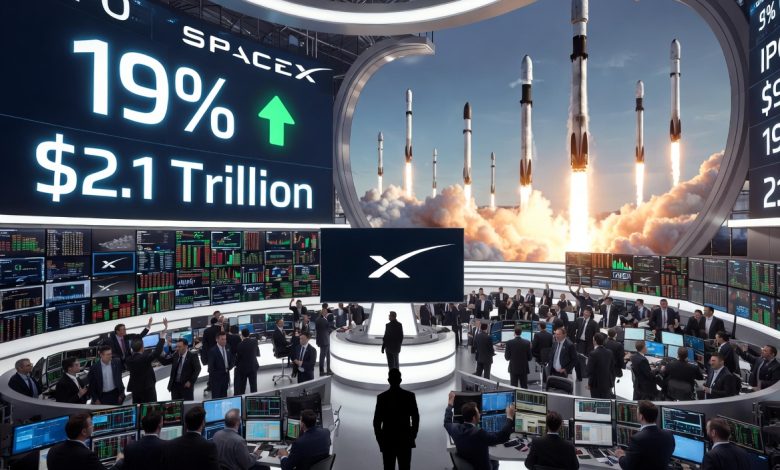
SpaceX achieved a historic milestone on Friday, June 12, 2026, as its highly anticipated initial public offering (IPO) launched on the Nasdaq stock exchange, marking a monumental shift in both the global space industry and the financial world. Under the ticker symbol SPCX, the company’s shares closed up 19% on its first day of trading, settling at around $161 per share and pushing the aerospace giant’s total market capitalization to a staggering $2.1 trillion. The record-breaking performance did not stop at the closing bell; a massive after-hours rally added approximately another $100 billion to the company’s valuation in extended trading, solidifying its place among the most valuable corporate empires on Earth.
The blockbuster debut follows SpaceX’s successful capital campaign, which raised an unprecedented $75 billion by pricing the IPO at $135 per share. During the debut session, intense market demand drove the stock to open at $150 before it ascended to an intraday peak of $176.52. High-volume trading dominated the session, with more than 500 million shares changing hands in a single day. This spectacular volume closely rivaled Facebook’s legendary 2012 public debut, which saw 580 million shares traded, highlighting the intense retail and institutional hype surrounding Elon Musk’s grandest venture.
SpaceX Makes History: Inside the Record-Breaking $75 Billion IPO
To put the scale of the SpaceX IPO into perspective, one must look at the previous records held in global financial history. Prior to Friday, the record for the largest initial public offering belonged to Saudi Aramco, the state-owned oil titan of Saudi Arabia, which raised $25.6 billion in 2019. SpaceX’s $75 billion capital raise completely dwarfs that figure, establishing a new high-water mark for corporate listings. The listing was heavily oversubscribed, drawing more than $250 billion in institutional and retail demand in the weeks leading up to the public float on Nasdaq.
SpaceX initially priced its shares at $135, valuing the company at a base of $1.77 trillion before trading commenced. However, the sheer volume of buy orders meant that the initial public offering price acted more as a springboard than a limit. This strategic capital injection is not merely a payout for early investors; rather, it represents a massive treasury that will directly fund humanity’s leap into a multi-planetary future.
SPCX Market Debut: Trading Dynamics and Friday’s Volatility
The market mechanics on Friday showed a deliberate effort by SpaceX and its lead underwriters to stabilize the stock amidst immense public hype. To dampen the extreme price swings typical of highly anticipated tech IPOs, SpaceX implemented a tiered lockup schedule for its employees and early-stage venture partners. Additionally, a significant allocation of shares—initially projected at 30% but later adjusted closer to 20%—was earmarked specifically for retail investors, allowing everyday traders to participate in the company’s growth from day one.
Opening Bell and Intraday Highs
At the opening bell, SPCX shares immediately bypassed the $135 offering price, opening at $150. This represented an instant 11% premium for those fortunate enough to secure shares at the IPO price. Momentum continued to build as the morning progressed, pushing the stock up over 30% to its daily high of $176.52. Although profit-taking in the afternoon pared back some of those gains, the stock found strong support above $160, ultimately closing at $160.95. This solid closing floor demonstrates robust institutional backing, indicating that large-scale fund managers are comfortable holding the stock at a multi-trillion-dollar valuation.
Comparing SPCX Volume to Facebook’s Legendary 2012 IPO
With more than 500 million shares (approximately 510 million shares) traded, SPCX’s debut represents one of the most liquid trading days in stock market history. The only comparable modern event is the Facebook IPO of 2012, which recorded 580 million shares traded. However, because of SpaceX’s much higher stock price, the total dollar value of the shares traded on Friday reached an astronomical $84 billion, far eclipsing the dollar volume of any previous market debut. This massive liquidity pool suggests that both institutional block-traders and speculative retail investors are heavily committed to the long-term trajectory of the stock.
The Trillion-Dollar Valuation: How SpaceX Redefined Wall Street Standards
A $2.1 trillion valuation places SpaceX in an elite tier of global companies, ranking it as the sixth-most valuable U.S. corporation, just behind tech behemoth Amazon. What makes this valuation unique is that SpaceX achieved it while operating in an industry historically known for extreme capital intensity and high failure rates. For decades, traditional aerospace and defense contractors functioned as slow-growing, dividend-paying entities heavily reliant on government contracts. SpaceX has completely shattered this paradigm, positioning itself as a high-growth tech platform that controls the literal gatekeeping infrastructure to orbit.
The company’s commercial and scientific operations are already running at a blistering pace; recently, SpaceX shatters record with back-to-back Falcon launches, showcasing their unparalleled launch frequency. By combining this reliable launching cadence with its commercial telecommunications and advanced AI applications, SpaceX has convinced the market that it is not just a rocket company, but a foundational layer of the future global economy.
Elon Musk’s Ascent to the World’s First Trillionaire
The astronomical success of the SPCX listing has rewritten the history of wealth accumulation, officially cementing Elon Musk as the world’s first-ever trillionaire. With his substantial supermajority stake in SpaceX, alongside his holdings in Tesla, Musk’s estimated net worth skyrocketed to $1.1 trillion by Friday’s closing bell. This monumental milestone eclipses the wealth of the world’s next richest individuals by an unprecedented margin, making Musk more than three times wealthier than Google co-founder Larry Page, who sits at approximately $293 billion.
While critics argue that much of this wealth is on paper and tied to volatile equity markets, the sheer liquid scale of SpaceX’s new public status provides Musk with an unparalleled financial war chest. It also validates his decades-long strategy of reinvesting nearly all of his capital into high-risk, high-reward ventures that most traditional venture capitalists avoided.
Where the Capital Goes: Funding Starship, Starlink, and Cosmic AI
The $75 billion raised through the IPO will not sit idle in corporate bank accounts. SpaceX has outlined a highly aggressive capital deployment strategy designed to accelerate several of its most ambitious technological projects.
Supporting Deep Space Exploration and Mars Colonization
A significant portion of the IPO proceeds is slated to fund the development and mass production of the Starship launch system. Starship is central to SpaceX’s ultimate mission: establishing a self-sustaining human colony on Mars. With fully reusable heavy-lift capabilities, Starship is designed to dramatically lower the cost per ton of payload delivered to deep space, transforming space exploration from a rare government-funded scientific endeavor into a thriving commercial marketplace.
Starlink Expansion and Orbiting AI Data Centers
Another major beneficiary of the capital injection is the Starlink satellite internet constellation. This capital influx will accelerate satellite connectivity, building on successful missions such as when the SpaceX Falcon Heavy deploys Viasat-F3 to complete global broadband coverage. By expanding its satellite array, SpaceX plans to offer high-speed, low-latency internet to every corner of the globe, providing a reliable stream of high-margin recurring revenue that will help subsidize its deep-space missions.
Furthermore, SpaceX is targeting a highly lucrative new market: space-based, solar-powered AI data centers. By deploying high-performance computing clusters directly into orbit, SpaceX intends to bypass the severe land, water, and grid-capacity constraints currently plaguing terrestrial AI data centers. These orbital servers will be cooled naturally by the vacuum of space and powered continuously by unfiltered solar energy, offering a highly sustainable alternative for massive computational models.
The Umbrella Empire: Incorporating xAI and X into SpaceX
Part of what justified the $2.1 trillion valuation in the minds of investors is SpaceX’s unique structure as a multi-industry conglomerate. Earlier this year, SpaceX completed an all-stock transaction valued at $250 billion to acquire xAI, Musk’s artificial intelligence venture. Because xAI had previously acquired the X social media platform (formerly Twitter) in a $33 billion all-stock transaction, both xAI and X now sit firmly under the SpaceX corporate umbrella.
This structural integration creates immense operational synergies. The real-time, global data stream generated by the X platform serves as a massive training ground for xAI’s neural networks. In turn, these advanced AI models are integrated into SpaceX’s autonomous flight software, Starlink’s dynamic routing algorithms, and the navigation systems of future Mars rovers. Musk’s broader technological ecosystem continues to draw intense spotlight, from the courtroom where the Elon Musk OpenAI trial court sketch was mocked to the stock market floor, showcasing how deeply integrated AI has become into his business strategies.
Analyst Outlook: Is the $2.1 Trillion Valuation Sustainable?
Despite the overwhelming success of Friday’s debut, Wall Street remains deeply divided on whether SpaceX can maintain its astronomical valuation over the long term. Bearish analysts point out that on a traditional cash-flow basis, SpaceX is highly overvalued. Many equity research firms peg the fundamental value of the company closer to $780 billion, suggesting that the current market price is driven more by retail euphoria and institutional FOMO (fear of missing out) than near-term balance sheet realities.
Conversely, bullish analysts argue that SpaceX cannot be analyzed using standard corporate metrics. As the sole entity capable of reliable, reusable orbital launches and global satellite internet delivery, the company holds a natural monopoly over the primary growth sectors of the 21st century. As long as SpaceX maintains its multi-year technological lead over competitors like Blue Origin and traditional defense contractors, investors appear more than willing to pay a premium for a piece of the cosmos.
Financial Summary: SpaceX IPO Performance at a Glance
The following table provides a comprehensive summary of SpaceX’s historic market debut and key trading metrics recorded on Friday, June 12, 2026:
| Financial Metric | IPO Offering / Target | Friday Day-One Closing | Intraday High / After-Hours |
|---|---|---|---|
| Share Price | $135.00 | $160.95 (Approx. $161) | $176.52 (High) / ~$168 (After-Hours) |
| Market Capitalization | $1.77 Trillion | $2.10 Trillion | +$100 Billion in Extended Trading |
| Capital Raised | $75 Billion | N/A | Largest Public Offering in History |
| Trading Volume | N/A | 500M+ Shares Traded | Approaching FB’s 580M in 2012 |
As the dust settles on this historic trading session, SpaceX has proven that the appetite for space exploration and high-frontier technology is stronger than ever. Whether the company can successfully scale its orbital data centers, colonize Mars, and maintain its multi-trillion-dollar valuation remains to be seen, but for now, SPCX has officially launched a new era of space-age capitalism on Wall Street.