Google Cloud Fraud Defense: The Next Evolution of reCAPTCHA 2026
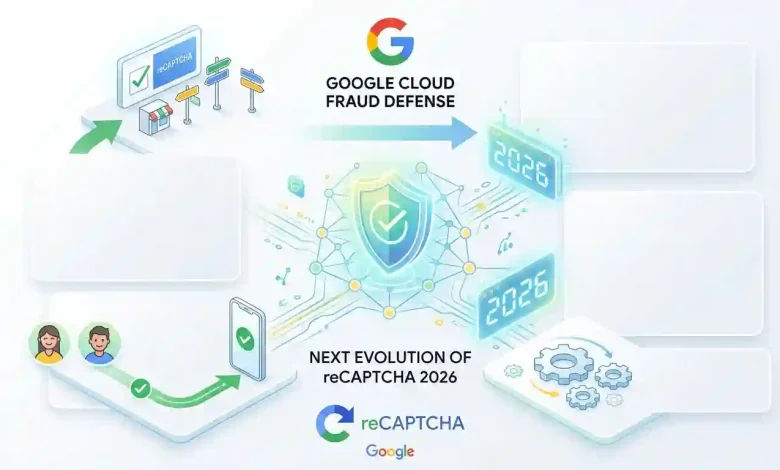
Table of Contents
Google Cloud Fraud Defense represents a paradigm shift in how modern enterprises handle digital trust, bot mitigation, and user verification in an increasingly automated world. As the digital landscape shifts away from human-only interactions toward a machine-dominated agentic web, security protocols must evolve to address new vulnerabilities. While autonomous AI agents promise frictionless transactions and hyper-efficient digital ecosystems, they also introduce a unique “Digital Paradox.” The very same artificial intelligence that accelerates digital commerce equips malicious actors with tools to deploy automated fraud at an industrial scale.
As tech giants face structural challenges, such as when AI data centers face halting buildouts due to power grid limitations and spatial demands, security infrastructure must optimize software efficiency and platform resilience. The agentic web creates a signal deficit for legacy security systems. Traditional models rely on human-centric telemetry like mouse movements, typing rhythms, and simple interaction times. Today’s generative AI can spoof these signals flawlessly, rendering classic bot detection tools obsolete.
While public attention often drifts toward geopolitical headlines, such as when conflicts escalate in key shipping lanes, digital security frameworks remain a silent, critical battlefield. Without an adaptive, robust layer of defense, enterprises risk massive revenue leakage to multi-stage AI fraud. The release of Google Cloud Fraud Defense marks a significant milestone. It replaces traditional gatekeeping methods with a comprehensive trust platform designed to verify intention, identify automated agents, and preserve the user experience.
Rebranding and Expanding: The Transition from reCAPTCHA to Google Cloud Fraud Defense
For over two decades, reCAPTCHA has served as the visual gatekeeper of the internet, prompting millions of users to identify fire hydrants, crosswalks, and traffic lights to prove their humanity. While reCAPTCHA Enterprise made significant strides by introducing invisible scoring mechanisms, the explosion of generative AI necessitated a fundamentally different paradigm. Security can no longer exist as a localized gateway at the login page. Instead, it must serve as an omnipresent trust fabric protecting the entire customer journey.
This systematic overhaul is critical to protecting digital economies. Just as market analysts watch how inflation threatens the global economy, cyber security professionals must guard against the silent draining of digital resources through card cracking, credential stuffing, and fake registrations. Legacy visual tests add unnecessary friction for real customers, leading to cart abandonment and degraded user satisfaction, while sophisticated AI models solve visual puzzles faster and more accurately than humans.
These complex, automated financial assaults mirror macro-level market disruptions, such as when oil prices spike due to sudden disruptions in supply networks. Google Cloud Fraud Defense moves past basic bot detection to address fraud end-to-end. By consolidating bot protection, Account Defense, SMS Defense, and Transaction Defense into a single unified platform, Google Cloud empowers security teams to apply granular trust metrics across registration, login, profile updates, and payment stages.
Key Capabilities of Google Cloud Fraud Defense
The core philosophy of Google Cloud Fraud Defense centers on three strategic components: Agentic Visibility, the Agentic Policy Engine, and AI-Resistant Challenges. Together, these elements enable digital applications to run smoothly without unnecessary blocks, distinguishing cleanly between legitimate automated agents, malicious scrapers, and human users.
Agentic Visibility: Mapping the AI Landscape
Agentic Visibility gives developers and administrators unprecedented insights into the non-human traffic navigating their systems. Not all automated traffic is harmful; search crawlers, helpful digital assistants, and integrated partner APIs are vital to the health of the modern internet. However, distinguishing these beneficial bots from destructive scraper networks requires high-fidelity threat intelligence.
Similar to political landscapes where high-profile figures pivot their approaches, such as when public figures like Laura Loomer reverse international stances, digital security frameworks must adapt to rapidly shifting profiles of trusted and untrusted automation. Google Cloud Fraud Defense utilizes Google-scale intelligence to analyze collective threat data, providing organizations with real-time classification of non-human traffic and giving clear visibility into exactly what types of AI agents are visiting their platforms.
The Agentic Policy Engine: Dynamic Control Over Machine Traffic
The Agentic Policy Engine gives enterprises the administrative tools needed to write fine-grained, conditional rules for traffic management. Security teams can establish policies that evaluate real-time risk scores alongside specific agent identities. This allows legitimate AI assistants to interact with the application while blocking malicious crawlers that attempt credential stuffing or inventory hoarding.
This level of auditing and specific control mimics highly regulated medical and safety standards, comparable to when specialized products like compounding peptides come under intense FDA scrutiny. Rather than employing blanket bans that shut down entire networks, the Policy Engine allows administrators to apply intelligent, localized friction based on verified trust profiles, geographic coordinates, and device integrity signals.
AI-Resistant Challenges: The QR Code Breakthrough
To defeat advanced AI bots that perfectly mimic human typing cadences and mouse navigation, Google has introduced the AI-Resistant Challenge. This system leverages the industry’s first secure device attestation model paired with QR code challenges to require human-in-the-loop validation without degrading overall platform accessibility.
While geopolitical crises, such as when geopolitical threats disrupt international relations, dominate news cycles, the silent escalation of AI-driven cyber threats presents an equal challenge to global commerce. When suspicious traffic is detected, Google Cloud Fraud Defense prompts a secure QR Code Challenge that must be scanned by a modern, verified mobile device. This interaction relies on Google Play Integrity and Apple DeviceCheck / App Attest APIs to ensure physical device possession, completely breaking the return on investment (ROI) for industrial-scale bot farms.

The Technical Architecture of Fraud Protection
Understanding the transition to this modernized security stack requires looking closely at how features have evolved over successive generations of Google’s security offerings. To secure applications, developers must choose the correct toolset based on their organization’s size, threat exposure, and development capabilities.
Much like cultural and historical organizations adjusting to public expectations, as seen when museum exhibits face critical warning sign changes, tech companies must modernize their core systems to maintain transparency, security, and public trust. The table below highlights how Google Cloud Fraud Defense expands upon and formalizes the legacy capabilities of earlier reCAPTCHA editions.
| Feature & Capability | reCAPTCHA Classic (v2 / v3) | reCAPTCHA Enterprise | Google Cloud Fraud Defense |
|---|---|---|---|
| Core Bot Defense | Basic visual/audio puzzles | Invisible telemetry-based scoring | AI-resistant adaptive engine |
| Agentic Web Visibility | None (blocks all automation) | Limited user-agent detection | Real-time agent identity & traffic classification |
| Policy Engine | No internal policy customization | Static rule matching | Dynamic Agentic Policy Engine (risk & identity-based) |
| Device Attestation | None | Basic device fingerprinting | Secure Play Integrity / Apple App Attest & QR validation |
| Journey Security Scope | Login/Registration only | Broad page protection | Unified flow (Account, SMS, Transaction, Checkout) |
Mitigating Multi-Stage Online Abuse
Google Cloud Fraud Defense is uniquely engineered to provide holistic protection across multiple specialized risk surfaces, recognizing that modern fraud is rarely confined to a single action. By leveraging specialized modules, organizations can build robust defenses against specific attack vectors:
- Account Defense: Protects against automated credential stuffing, synthetic account creation, and Account Takeover (ATO) attempts. By monitoring registration and login touchpoints, the platform flags suspiciously synchronized signups and suspicious credential patterns before unauthorized access can occur.
- SMS Defense: Stops highly costly SMS toll fraud, where automated bots trigger thousands of verification messages to premium-rate phone numbers. This layer keeps SMS-based user verification pathways safe and protects enterprise marketing and operations budgets from sudden artificial spikes.
- Transaction Defense: Shields the checkout and payment process by checking for card cracking, rapid-fire transactions, and automated checkouts. This ensures that only legitimate, validated shoppers can complete purchases, keeping chargebacks and processing fees low.
Operational Impact and Implementation Strategies
For existing users of reCAPTCHA and reCAPTCHA Enterprise, migrating to Google Cloud Fraud Defense is designed to be seamless. Google has published migration guides allowing developers to transition existing cryptographic keys, refine site-specific scoring models, and utilize client libraries across web and mobile platforms. By wrapping these systems in a unified developer console, the platform minimizes implementation overhead while providing immediate access to next-generation defenses.
The platform integrates smoothly with other cloud offerings, including Google Cloud Security platform solutions and Google Cloud Armor. This integration enables edge-level enforcement, blocking malicious actors before their requests ever reach the application server. This design significantly reduces computing costs and allows scaling applications to handle traffic spikes safely.
The Future of Digital Trust and Autonomous Transactions
The internet is undergoing a rapid transition toward a highly automated, agentic economy. Securing this new landscape requires platforms to move away from rigid, legacy gatekeeping and adopt active trust models. By providing granular agent visibility, robust device-level validation, and flexible controls, Google Cloud Fraud Defense sets a new standard for modern application security.
Embracing these cutting-edge capabilities enables businesses to safely welcome the innovations of tomorrow. Security is transformed from an obstacle into an engine for business growth, fostering digital trust for both humans and autonomous agents in a rapidly evolving connected world.





One Comment