US :The Great AI Heist: How China Uses Model Distillation to Circumvent US Chip Curbs 2026
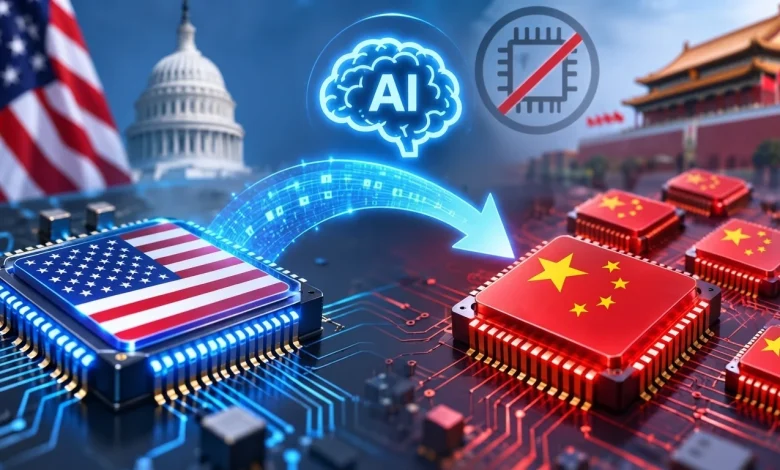
Table of Contents
In an increasingly fractured technological landscape, a quiet but high-stakes battle is unfolding over the intellectual architecture of artificial intelligence. Recent evidence, derived from an extensive review of over 300 Chinese academic papers, corporate filings, and government strategy documents, suggests that Chinese entities have refined a process known as AI model distillation to bridge the gap left by stringent US-imposed chip export controls.
The Strategic Rise of AI Model Distillation
Model distillation is an algorithmic technique wherein a smaller, more efficient model learns from the output of a larger, more powerful “teacher” model. While originally intended for optimizing efficiency, its current application in the Chinese AI ecosystem represents a strategic pivot. By funneling the knowledge of leading American foundational models—such as GPT-4 or Claude—into smaller domestic models, Chinese companies are effectively inheriting the “reasoning capabilities” of superior architecture without needing access to the massive computational clusters that were originally required to create them.
The practice of model distillation has evolved from a laboratory curiosa into a cornerstone of industrial strategy in the race for AI dominance.
From Academic Experiment to Industrial Mainstream
Historically, the use of AI outputs to train domestic models was considered a niche, often experimental, practice within academic research. However, the data reveals a marked transition. Recruiters for major Chinese tech firms are increasingly seeking talent with deep expertise in “model alignment” and “knowledge extraction.” This is not merely an attempt to cut development time; it is a systematic industrial initiative to maintain pace with the West while grappling with the limitations of hardware availability. For further insight into the broader tech landscape, readers may find our recent coverage on recent software AI discoveries useful for context.
Navigating the Impasse: Offsetting US Export Restrictions
US policies have effectively restricted China’s access to high-end GPUs like the NVIDIA H100 and B200, which are essential for training frontier models from scratch. While companies like Moonshot AI face challenges in maintaining capacity, the distillation approach acts as a force multiplier. By distilling the “wisdom” of elite American models, domestic firms can achieve benchmark performance that would otherwise necessitate thousands of restricted chips. This practice is fundamentally changing the calculus of compute scarcity.
The Methodology: How Distillation Works
At its core, distillation requires the “teacher” model to process a massive, diverse dataset and generate responses or classifications. These outputs then serve as the “ground truth” training data for the smaller “student” model. Because the teacher model has already distilled complex linguistic and logical patterns, the student model requires significantly less computational power to achieve comparable performance. This clever work-around is detailed extensively in recent Chinese patent filings, which emphasize techniques to automate the generation of synthetic datasets using API-driven access to American foundational models.
Geopolitical Implications and Future Outlook
The implications for global technology policy are profound. The democratization of AI power via distillation suggests that hardware restrictions alone may not be sufficient to contain the rise of global AI rivals. As domestic firms refine these pipelines, the dependency on Western hardware may shift from a binary state to a hybrid model of domestic innovation supported by foreign architectural wisdom. Furthermore, the resilience of these markets is often tied to broader financial trends, as seen in the recent Nasdaq selloff linked to AI sectors. Moving forward, the focus will likely shift toward tighter scrutiny of API usage logs and model output watermarking to detect, and potentially limit, the unauthorized distillation of proprietary intellectual property.