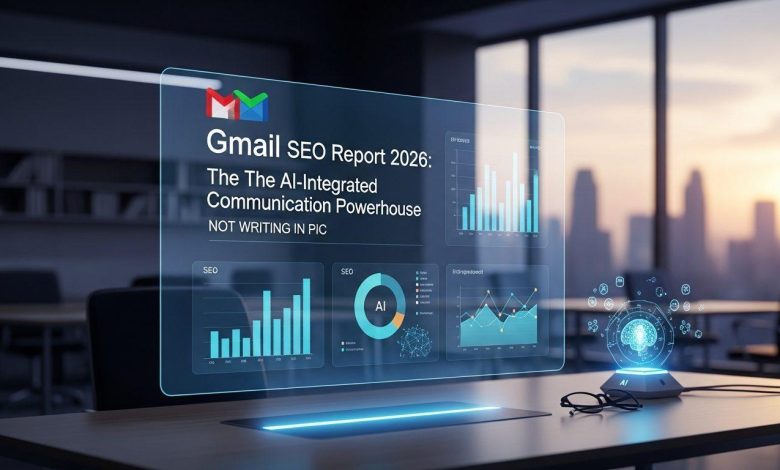
Gmail SEO Report 2026: The AI-Integrated Communication Powerhouse
Executive Summary: Market Dominance & Architecture
As of early 2026, Gmail remains the dominant force in the global email landscape, serving over 1.8 billion active users active monthly. Far surpassing its origins as a simple AJAX-based webmail service launched in 2004, Gmail has evolved into a central node within the Google Workspace ecosystem, functioning as a primary identity provider (IdP) and a data repository for billions of personal and enterprise workflows.
The platform’s dominance is not merely statistical but architectural. By leveraging cloud-native infrastructure and increasingly integrating Large Language Models (LLMs) via the Gemini engine, Gmail has transitioned from a passive message store to an active, intent-aware communication assistant.
The “Gemini Era”: Generative AI & Semantic Understanding
The most significant shift in Gmail’s recent development is the deep integration of Google Gemini (formerly Duet AI). This move marks the transition from heuristic-based features (like standard spam filters) to generative semantic analysis.
Core AI Features in 2026
- AI Inbox & Contextual Summarization: Utilizing the Gemini 3 Flash model, Gmail can now synthesize complex email threads into concise executive summaries, extracting action items and deadlines automatically.
- Generative Drafting (“Help Me Write”): Users can prompt the interface to draft emails with specific tones (formal, concise, persuasive) using context-aware tokens from previous interactions.
- Cross-App Data Retrieval: Advanced RAG (Retrieval-Augmented Generation) capabilities allow Gmail to query data from Google Drive and Docs to answer user queries directly within the inbox (e.g., “Find the flight dates from the attached PDF in last week’s email”).
- Smart Compose & Nudging: Predictive text algorithms now utilize long-context windows to suggest full sentence completions that mimic the user’s personal stylistic idiolect.
Security Protocols: Post-Quantum Cryptography (PQC)
In response to the looming threat of “Harvest Now, Decrypt Later” attacks, Gmail has implemented cutting-edge Post-Quantum Cryptography (PQC) standards. This ensures that data encrypted today remains secure against future quantum computing decryption capabilities.
Technical Note: Google has deployed ML-KEM (Kyber768) for TLS 1.3 key encapsulation. This hybrid key exchange mechanism protects the transport layer between Chrome/Gmail clients and Google servers, mitigating quantum cryptanalysis threats.
Standard Security Layers
- BIMI (Brand Indicators for Message Identification): Support for VMC (Verified Mark Certificates) allows organizations to display authenticated logos, reducing phishing success rates.
- MTA-STS: Strict Transport Security ensures emails are delivered only over encrypted SMTP connections, preventing man-in-the-middle (MITM) downgrade attacks.
- TensorFlow Spam Filters: Utilizing deep learning to block 99.9% of spam, phishing, and malware before they reach the inbox.
Productivity & Advanced Search Operators
For power users and SEO professionals, mastering Boolean search operators is essential for managing massive data repositories. Gmail’s search engine supports complex query strings that bypass the need for folder structures.
| Operator | Function | Use Case Example |
|---|---|---|
has:attachment |
Filters emails containing files. | invoice has:attachment -filename:jpg |
category: |
Filters by smart tab (Primary, Social, Updates). | category:updates "delivery" |
older_than: / newer_than: |
Time-based filtering. | label:promotions older_than:2y |
+ (Exact Match) |
Forces exact word match (no synonyms). | +"marketing budget" |
deliveredto: |
Finds emails sent to specific alias variations. | deliveredto:username+netflix@gmail.com |
Comparative Analysis: Gmail vs. Competitors
While Microsoft Outlook and Apple Mail remain strong competitors, Gmail’s cloud-native approach offers distinct advantages in search speed and AI integration.
| Feature | Gmail (Google Workspace) | Microsoft Outlook (365) | Apple Mail |
|---|---|---|---|
| AI Engine | Gemini (Deep integration with Docs/Drive) | Copilot (Strong enterprise graph integration) | Apple Intelligence (On-device processing focus) |
| Search Capability | Near-instant, supports Regex-like operators. | Slower on large mailboxes; heavily indexed based. | Device-dependent indexing (Spotlight). |
| Security | Cloud-side filtering, PQC (Kyber768). | Enterprise Defender, heavily admin-controlled. | Mail Privacy Protection (pixel blocking). |
Future Outlook: The Autonomous Agent Interface
Looking ahead, Gmail is evolving into an autonomous agent interface. The distinction between “email” and “task management” is blurring. Future updates are expected to allow Gemini to autonomously negotiate meeting times, draft replies for user approval, and organize complex project threads into linear narratives, effectively turning the inbox into a project management dashboard.
Sources & References
- •
Google Workspace Updates Blog (2026) - •
NIST Post-Quantum Cryptography Standardization - •
Demandsage Gmail Statistics 2025/2026 - •
Google Security Blog: Toward Quantum-Resistant Cryptography




One Comment