NYT Connections: The Ultimate Guide, Strategies, and 2026 Updates
Executive Insights
- Connections is a daily categorization puzzle with four difficulty levels: Yellow, Green, Blue, and Purple.
- The ‘Purple’ category is the hardest and often involves wordplay or fill-in-the-blank phrases rather than definitions.
- A key strategy is to use the ‘Shuffle’ button to break visual patterns and avoid ‘red herrings’ (words that look like they fit but don’t).
- The game was created by Wyna Liu and launched in beta in June 2023.
- As of 2026, the game has expanded to include a Sports Edition and an official archive for subscribers.
Since its beta launch in June 2023, Connections has cemented itself as the intellectual chaser to Wordle’s appetizer. Now in February 2026, it stands as the second-most-played game in The New York Times’ digital portfolio, captivating millions with its deceptive simplicity. Unlike Wordle’s vocabulary test, Connections is a test of lateral thinking, cultural knowledge, and the ability to spot—and avoid—cleverly designed traps.
Whether you are a seasoned solver looking to improve your streak or a newcomer confused by the “Purple” category, this comprehensive guide covers everything from advanced solving algorithms to the latest spin-offs like the Sports Edition.
How to Play Connections: The Rules
The premise is elegant: You are presented with a 4×4 grid of 16 words. Your goal is to sort them into four distinct groups of four words each. Each group shares a common theme or category.
The Mechanics
- Selection: Tap four words to create a group and press “Submit.”
- Lives: You have four “mistakes” available. If you guess incorrectly, a life is lost.
- One Away: If your guess is correct for three out of four words, the game will flash a “One Away…” warning. This is your most valuable feedback loop.
- Success: When a group is correctly identified, it clears from the board and reveals its category name and color.
Decoding the Difficulty Colors
One of the most critical aspects of Connections is the color-coded difficulty scale. The colors are not random; they indicate the abstractness of the category. Knowing this helps you predict what kind of logic the editor, Wyna Liu, is employing.
| Color | Difficulty | Typical Logic | Example |
|---|---|---|---|
| Yellow | Straightforward | Simple synonyms or clear associations. | Types of Fruit: Apple, Banana, Pear, Grape |
| Green | Medium | Trivia or slightly more specific categories. | Golf Terms: Driver, Iron, Eagle, Putt |
| Blue | Hard | Niche knowledge, pop culture, or specific fields. | Rappers: Drake, Future, Common, Logic |
| Purple | Tricky | Wordplay, fill-in-the-blank, palindromes, or homophones. | Words ending in specific letters, or words that follow “Holy ____” |
Strategies for Success
To consistently solve Connections without burning your four mistakes, you need to move beyond guessing and start profiling the board.
1. Beware the Red Herring
The game is designed to trick you. The editor intentionally includes five or six words that could fit a category, but only four actually do. For example, you might see Rose, Violet, Daisy, Lily, and Bud. While they all seem floral, “Bud” might actually belong to a category like “Beer Brands” (Bud, Miller, Coors, Corona).
2. The “Shuffle” Button is Essential
Our brains are wired to see patterns in proximity. If “Rock” and “Stone” are next to each other, you will fixate on them. Hitting Shuffle breaks this visual bias and forces you to see new relationships.
3. Solve Purple First (Reverse Engineering)
Novice players hunt for the Yellow category immediately. Experts scan for the Purple category first. Why? Because Purple categories often rely on wordplay rather than meaning (e.g., “Words that start with a planet”). If you can spot the “fill-in-the-blank” trick early, you remove the most dangerous words from the board, making the remaining synonyms easier to group.
4. Pause on “One Away”
When you get the “One Away” message, do not immediately swap one word and guess again. This is the fastest way to lose. Instead, unselect all words and look at your group of four. Ask yourself: “Which of these is the imposter?” Usually, the imposter has a secondary meaning that fits another category perfectly.
The Evolution of Connections (2023–2026)
The Wyna Liu Era
Associate Puzzle Editor Wyna Liu is the creative force behind the puzzles. She has spoken openly about her design philosophy, noting that she enjoys the “constructive frustration” players feel. Her signature style involves categories that span parts of speech or rely on visual puns.
New Modes and Updates
By early 2026, the Connections ecosystem expanded significantly:
- Connections: Sports Edition: Officially launched in February 2025, this version focuses on teams, athletes, and terminology. It introduced a slightly different difficulty curve, often relying on team rosters and stats history.
- The Archive Controversy: In late 2024, the NYT cracked down on third-party archive sites. Now, the only official way to play past puzzles is through the NYT Games app archive feature, which was eventually rolled out to subscribers.
Why Is It So Popular?
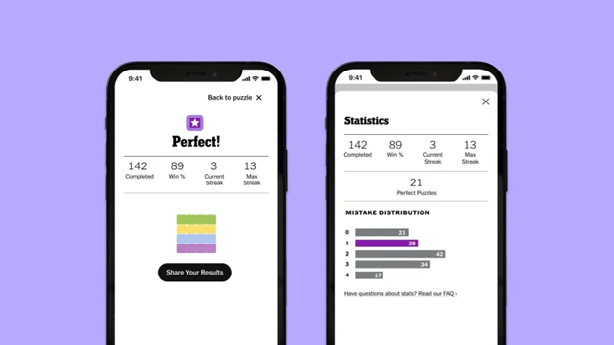
Psychologically, Connections hits a sweet spot that Wordle misses. Wordle is a test of elimination; Connections is a test of categorization. Humans are pattern-matching machines. When we see chaos (16 random words) and organize it into order (4 neat groups), we get a dopamine hit. The shareable grid—colored squares without spoilers—allows for social bragging rights without ruining the puzzle for others.
Tools and Resources
While cheating ruins the fun, getting a nudge is sometimes necessary.
- NYT Games App: The primary hub for play, offering stats tracking and streaks.
- Connections Bot: Similar to the Wordle Bot, this AI analysis tool (introduced for subscribers) breaks down the difficulty of that day’s board and rates your performance.
In-Depth Q&A
Q: When does the NYT Connections puzzle reset?
The puzzle resets daily at midnight local time. However, if you are playing via the NYT News app or Games app, it may sync to New York time (ET) depending on your device settings.
Q: What do the colors mean in NYT Connections?
The colors represent difficulty levels. Yellow is the easiest (straightforward synonyms), Green is medium, Blue is hard (often trivia or niche knowledge), and Purple is the trickiest (wordplay, fill-in-the-blanks, or puns).
Q: Can I play past Connections puzzles?
Yes, as of 2026, the NYT Games app includes an archive feature for subscribers allowing you to play past puzzles. Third-party archive sites have largely been shut down due to copyright enforcement.
Q: Who creates the NYT Connections puzzles?
The puzzles are primarily edited by Wyna Liu, an associate puzzle editor at The New York Times. Her specific style of ‘red herrings’ and wordplay has defined the game’s voice.
Q: What is the Connections Sports Edition?
launched in early 2025, the Sports Edition is a standalone variant of the game developed in collaboration with The Athletic. It focuses specifically on sports knowledge, teams, and athletes.