North Korea rocket motor 2026 test: 250-ton thrust analyzed
The Dawn of 255 Tons-Force: Technical Breakdown of the 2,500 kN Engine
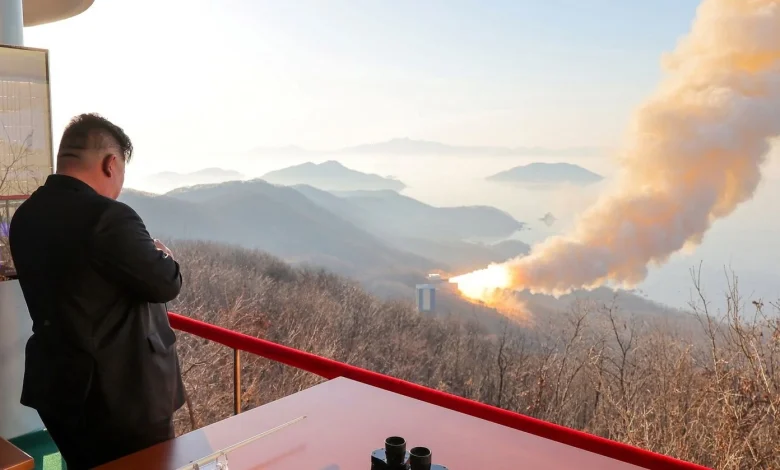
The sheer power of a 2,500 kN thrust engine places North Korea’s rocketry program in an elite echelon of aerospace development. To understand the magnitude of this achievement, one must examine the physics and engineering required to harness 255 tons-force of thrust. This metric indicates an engine capable of lifting an enormously heavy payload—potentially multiple independently targetable reentry vehicles (MIRVs) or an extraordinarily heavy hypersonic glide vehicle—into the upper atmosphere and beyond. The ground test visibly demonstrated a highly stable exhaust plume, suggesting advanced propellant grain geometry and highly uniform combustion rates.
| Missile Engine Era | Estimated Thrust (kN) | Propellant Type | Structural Materials | Primary Strategic Purpose |
|---|---|---|---|---|
| Pre-2017 (Hwasong-14) | ~400 – 500 kN | Liquid (UDMH/N2O4) | Standard Aerospace Steel alloys | Early ICBM Prototyping |
| 2023 (Hwasong-18) | ~1,400 kN | Solid Fuel | Basic Composites & Aluminum | Advanced ICBM Deployment |
| March 2026 (New Test) | ~2,500 kN (255 tons-force) | Solid Fuel | Carbon-Fiber Composites | Next-Gen Heavy ICBM / MIRV Delivery |
Why Solid-Fuel Surpasses Liquid-Fuel
Historically, North Korea relied heavily on liquid-fueled rocket engines. While liquid propellants can offer high specific impulse (efficiency), they come with severe logistical drawbacks. Liquid-fueled ballistic missiles generally require fueling on the launch pad immediately prior to firing, a process that can take hours. This fueling window exposes the missile and its launch crew to preemptive strikes from adversarial air forces and satellite surveillance networks.
Solid-fuel rockets, by contrast, are pre-loaded with a mixture of fuel and oxidizer bound together in a rubbery matrix. This allows the missile to be stored in a ready-to-fire state for months or even years. When the order is given, a solid-fuel missile can be rolled out of a fortified subterranean bunker and launched in a matter of minutes. The successful test of a 2,500 kN solid-fuel engine proves that North Korea has not only mastered solid-propellant chemistry but has scaled it up to support the heaviest classes of intercontinental ballistic missiles.
The Role of Carbon-Fiber Composites in Modern Rocketry
One of the most alarming aspects of this 2026 test is the confirmed use of carbon-fiber composites in the rocket motor casing and nozzle. Rocket engines operating at 255 tons-force generate unimaginable internal pressures and temperatures. Traditional steel or titanium casings are heavy; every kilogram of engine casing weight is a kilogram less of nuclear payload or decoy countermeasures that the missile can carry.
Carbon-fiber composites offer a revolutionary solution. They boast a tensile strength vastly superior to steel while weighing a fraction of traditional metals. By wrapping the solid propellant grain in a wound carbon-fiber casing, North Korean engineers have drastically improved the missile’s mass fraction. This means the engine is fundamentally more efficient, allowing the rocket to fly further, carry heavier warheads, and reach higher terminal velocities. The intricate manufacturing techniques required to wind carbon fiber for a 2,500 kN engine strongly suggest that Pyongyang has illicitly acquired advanced manufacturing machinery or has successfully indigenized the production of high-end aerospace composites despite severe international sanctions.
Geopolitical Ramifications: US, South Korea, and the Pacific
The strategic balance of power in the Indo-Pacific region is experiencing seismic shifts in the wake of this engine test. For Washington, Seoul, and Tokyo, the window to detect, track, and intercept a North Korean launch is rapidly shrinking. A solid-fuel ICBM equipped with this new motor could theoretically launch from a heavily forested, mobile transporter-erector-launcher (TEL) with less than five minutes of actionable warning time.
The United States military must re-evaluate its regional posture. As domestic agencies navigate complex administrative hurdles—such as those detailed in the comprehensive 2026 funding analysis of the DHS shutdown status—the Department of Defense is forced to maintain an outward-facing posture of absolute readiness. The Pacific Command faces the grim reality that preemptive strike doctrines, commonly referred to as the ‘Kill Chain’ strategy in South Korea, are fundamentally undermined by the rapid launch capabilities inherent to advanced solid-fuel systems. If the enemy can launch before they are detected fueling, the preemptive strategy crumbles.
Global Escalations and the Axis of Tension
North Korea’s technological leaps do not occur in a geopolitical vacuum. The successful 250-ton thrust motor test is a crucial node in a broader tapestry of global instability. Western analysts have long warned of a burgeoning defense technology sharing network between Pyongyang, Moscow, and Tehran. The acceleration of North Korea’s composite materials and solid-fuel programs may be the result of tacit knowledge transfers from these allied autocracies.
The strategic naval theater is already stretched thin, particularly as Iran targets Diego Garcia in a 2026 strategic naval escalation, pulling American carrier strike groups toward the Indian Ocean. This overextension is further highlighted by recent aviation emergencies, such as the US F-35 Iran incident in 2026, demonstrating the immense pressure on allied aerial assets. When the United States is forced to continuously divert high-end military assets to manage crises in the Middle East, North Korea seizes the opportunity to aggressively push the boundaries of its strategic deterrent in the Pacific without facing undivided American military focus.
Simultaneously, autocratic regimes are tightening their grip on information warfare, perfectly illustrated by the Russia internet crackdown of 2026, which serves to insulate these nations from Western diplomatic pressure and economic sanctions, ensuring that black-market supply chains for aerospace components remain deeply obscured from international inspectors.
Kim Jong Un’s Strategic Vision for 2026
Supreme Leader Kim Jong Un’s personal presence at the 250-ton thrust motor test is highly symbolic and deeply embedded in his broader strategic vision for 2026. At the Eighth Party Congress, Kim outlined an ambitious five-year military modernization plan, explicitly calling for the development of super-large nuclear warheads, solid-fuel ICBMs, hypersonic gliding flight warheads, and nuclear-powered submarines. This engine test represents the realization of one of the most technologically demanding pillars of that manifesto.
By publicly associating himself with the test, Kim is sending a dual message. Domestically, he is reinforcing his image as a visionary military architect, securing loyalty among the military elite and projecting strength to the populace despite ongoing economic hardships. Internationally, he is signaling to the incoming diplomatic administrations in Washington and allied capitals that North Korea will negotiate only from a position of absolute nuclear strength. The DPRK is no longer merely seeking a deterrent; it is building a war-fighting nuclear arsenal designed to defeat modern missile defense architectures.
Missile Defense Systems on High Alert
The advent of a 2,500 kN solid-fuel ICBM drastically complicates the mission of global missile defense systems. Current architectures, such as the Ground-Based Midcourse Defense (GMD) system in Alaska and California, the Terminal High Altitude Area Defense (THAAD) deployed in South Korea, and the Aegis Ballistic Missile Defense system on naval destroyers, are calibrated against historical trajectory models and burn times.
A motor with 255 tons-force of thrust alters the fundamental kinematics of the missile’s ascent phase. A faster burnout time means the missile spends less time in the vulnerable boost phase, during which it is theoretically easiest to intercept because the exhaust plume is highly visible to infrared early warning satellites. To understand the profound difficulties of intercepting modern ballistic threats, one can look at analyses from international defense watchdogs. According to reports from institutions like Reuters, adversarial innovations in thrust profiles and maneuverable reentry vehicles continuously force defensive networks into expensive and complex software and hardware modernization cycles.
Assessing the Intercontinental Ballistic Missile (ICBM) Threat
If this new carbon-fiber composite engine is integrated into a multi-stage ICBM, the payload capacity of the resulting weapon will be devastating. Early estimates suggest that a three-stage missile utilizing this 2,500 kN motor as its first stage could comfortably deliver a payload exceeding 3,000 kilograms to the continental United States.
A payload of this size is highly concerning because it permits the integration of Multiple Independently Targetable Reentry Vehicles (MIRVs) along with sophisticated penetration aids (penaids) such as radar-reflecting balloons, electronic jammers, and thermal decoys. When a single missile can release three or four distinct nuclear warheads alongside dozens of decoys, it threatens to overwhelm the mathematical intercept capacities of existing defense interceptors. The sheer thrust of the 2026 engine test guarantees that North Korea now possesses the brute force necessary to loft these heavy, complex kill vehicles into space.
Future Projections: What Comes After the 2,500 kN Thrust Test?
The successful ground test of the 250-ton thrust solid-fuel motor is not the culmination of North Korea’s aerospace ambitions; rather, it is the foundational building block for the next decade of military expansion. In the immediate future, intelligence agencies anticipate a full-scale flight test of a new ICBM—potentially designated the Hwasong-19 or a completely new nomenclature—incorporating this carbon-fiber motor. Such a flight test would likely be conducted on a highly lofted trajectory, plunging into the Sea of Japan, to avoid flying over neighboring countries while still demonstrating maximum altitude and engine burnout characteristics.
Furthermore, this immense thrust capability could be dual-purposed for North Korea’s space program. A modified version of this engine could serve as the booster for heavier military reconnaissance satellites, allowing Pyongyang to establish a more persistent and capable ‘eye in the sky’ to monitor South Korean and American troop movements.
In conclusion, the March 2026 rocket motor test reshapes the strategic calculus of the Korean Peninsula and the world. By mastering carbon-fiber composites and achieving an unprecedented 255 tons-force of thrust from a solid-fuel grain, North Korea has demonstrated engineering resilience that continually defies international embargoes. The global community now faces an adversary equipped not just with nuclear ambitions, but with the cutting-edge aerospace delivery mechanisms required to actualize them on a terrifying, transcontinental scale. The next chapter of nuclear deterrence has begun, driven by the fiery exhaust of a 2,500 kiloNewton engine.