India-US Trade Deal 2026: Tariff Cuts, Russian Oil Pivot & The $500B Pact
Executive Insights
- Tariff Reset: US tariffs on Indian exports cut from 50% to 18%; India moves toward zero tariffs on US imports.
- Russian Oil Halt: India agrees to stop buying Russian crude, pivoting to US and Venezuelan energy sources.
- $500 Billion Commitment: India pledges massive purchases in energy, technology, and agriculture.
- Semiconductor Boom: The deal creates a $100 billion opportunity for India’s tech sector, aiding ISM 2.0 goals.
- Strategic Realignment: The agreement solidifies the ‘China Plus One’ strategy and integrates India into the US critical minerals supply chain.
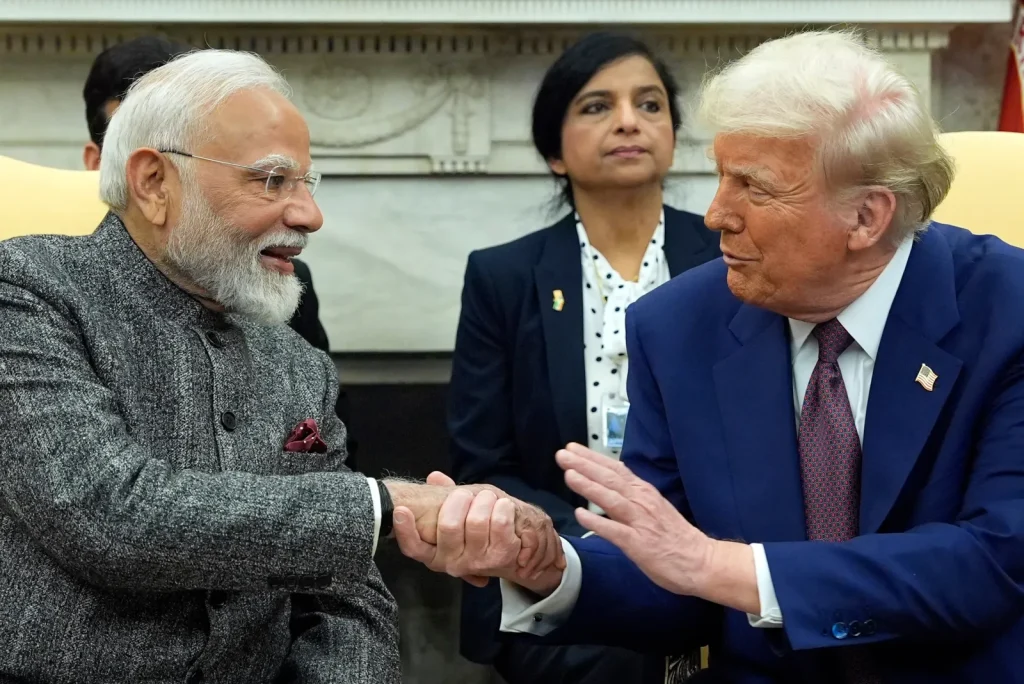
Analyzing the landmark February 2026 agreement between President Donald Trump and Prime Minister Narendra Modi, redefining tariffs, energy security, and semiconductor supply chains.
Introduction: The “Feb 2” Breakthrough
On February 2, 2026, the United States and India announced a transformative trade agreement that ends months of escalating economic tension. Following a period where US tariffs on Indian goods had spiked to 50% (driven by disputes over Russian oil purchases), President Donald Trump and Prime Minister Narendra Modi have sealed a deal that resets the bilateral economic landscape.
The deal slashes US tariffs on Indian exports to 18%, while India has committed to a strategic pivot away from Russian crude oil and a massive $500 billion purchase commitment across energy, technology, and agriculture sectors. This agreement marks a decisive moment for the China Plus One strategy, solidifying India’s role as a trusted manufacturing hub for electronics and semiconductors.
Key Provisions of the 2026 Trade Agreement
The deal is structured around reciprocal tariff reductions and high-value strategic commitments. Below is a breakdown of the core terms:
| Provision | Previous Status (Late 2025) | New 2026 Agreement Terms |
|---|---|---|
| US Tariffs on Indian Goods | 50% (25% Reciprocal + 25% Punitive) | 18% (Punitive tariffs removed) |
| India Market Access | Varied/High Tariffs | Moving toward Zero Tariffs & elimination of non-tariff barriers |
| Energy Sourcing | Heavy reliance on Russian Crude | Halt Russian Oil; Shift to US & Venezuelan sources |
| Purchase Commitment | N/A | $500 Billion (Energy, Tech, Coal, Agriculture) |
The $100 Billion Semiconductor Opportunity
A centerpiece of the deal is the deeper integration of the US-India Initiative on Critical and Emerging Technology (iCET). Industry experts project this deal paves the way for a $100 billion opportunity in the electronics and semiconductor sectors.
- Tariff Truce for Tech: The reduction to an 18% tariff ceiling provides critical stability for manufacturers of smartphones and telecom equipment, encouraging companies to scale export-oriented production in India.
- ISM 2.0 Integration: The deal complements the India Semiconductor Mission (ISM) 2.0, which focuses on equipment, materials, and R&D. The removal of trade barriers is expected to accelerate the flow of advanced capital equipment needed for new fabs.
- Trusted Supply Chains: By aligning with the US TRUST initiative, India solidifies its position as the primary alternative to China for high-tech manufacturing, specifically in Open RAN subsystems and secure network equipment.
Critical Minerals and “Project Vault”
The trade deal coincides with the US announcement of “Project Vault,” a $12 billion initiative to stockpile critical minerals. This has immediate implications for US-India relations:
- Strategic Alignment: External Affairs Minister S. Jaishankar’s participation in the Critical Minerals Ministerial (Feb 3-4, 2026) highlights the deal’s extension beyond mere goods trade into national security.
- Supply Chain Resilience: The agreement facilitates smoother cooperation on extracting and processing rare earth elements, reducing dependence on Chinese dominance.
Energy Shift and Agricultural Opening
The Russian Oil Pivot
Perhaps the most geopolitically significant aspect is India’s agreement to halt purchases of Russian crude oil. This marks a major victory for US foreign policy and a potential strain on India-Russia relations. India will replace this supply with increased imports from the United States and potentially Venezuela.
Agriculture & “Buy American”
India has committed to a “Buy American” policy at unprecedented levels. For the US agriculture sector, this implies the removal of longstanding non-tariff barriers, potentially opening India’s vast consumer market to US dairy, nuts, and produce—a move that has historically been sensitive for Indian policymakers.
Geopolitical Implications
This deal creates a “Mega Partnership” that realigns the Indo-Pacific power balance. By effectively decoupling India’s energy needs from Russia and its tech supply chain from China, the US has cemented India as its primary strategic partner in Asia. However, the domestic impact in India regarding the opening of agricultural markets and the cost of energy transition remains a critical space to watch in the coming months.
In-Depth Q&A
Q: What are the new tariff rates under the India-US Trade Deal 2026?
The US has reduced tariffs on Indian goods from a high of 50% down to 18%. In return, India has committed to moving toward zero tariffs on US goods and eliminating non-tariff barriers.
Q: Does the 2026 trade deal affect India’s purchase of Russian oil?
Yes. A key condition of the deal is India’s agreement to halt the purchase of Russian crude oil and shift its energy sourcing to the United States and potentially Venezuela.
Q: What is the total value of the purchase commitment made by India?
India has committed to purchasing over $500 billion worth of US products across sectors including energy, technology, coal, and agriculture.
Q: How does this deal impact the semiconductor industry?
The deal is expected to unlock a $100 billion opportunity for the electronics and semiconductor sectors by stabilizing tariffs, easing the flow of capital equipment, and deepening cooperation under the iCET and TRUST initiatives.
Q: What is Project Vault and how does it relate to the trade deal?
Project Vault is a $12 billion US initiative to stockpile critical minerals. It aligns with the trade deal by fostering closer India-US cooperation on resilient supply chains for rare earth elements essential for defense and tech.




5 Comments