Drop Tower Technology: From Microgravity Physics to Hyper-Vertical Thrills
Introduction
A drop tower is a specialized vertical structure designed to create a controlled environment of free fall. While widely recognized as adrenaline-inducing amusement rides, these engineering marvels serve a critical role in scientific research, enabling physicists to simulate microgravity conditions without leaving Earth’s atmosphere. Whether facilitating sub-orbital material testing or delivering 4-G vertical launches, the drop tower represents a pinnacle of kinetic engineering, relying on precise pneumatics, magnetic braking systems, and aerodynamic drag reduction.
The Physics of Vertical Descent
The core principle of any drop tower is the creation of a weightless state by allowing a payload—whether a scientific capsule or a passenger gondola—to fall under the influence of gravity alone. In a true free fall, the only force acting on the object is gravity ($g \approx 9.81 m/s^2$).
Microgravity Generation
For scientific applications, achieving a high-quality microgravity environment (often $10^{-6}g$) requires eliminating air resistance. Research towers utilize two primary methods:
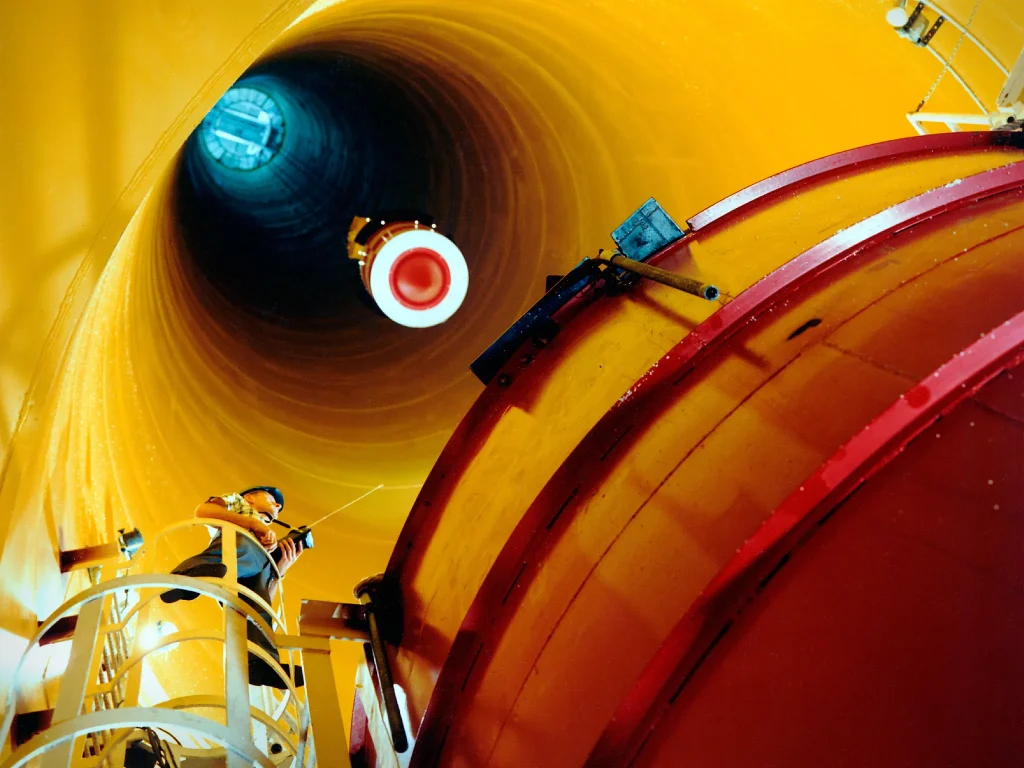
- Evacuated Tubes: Facilities like the NASA Glenn Research Center pump air out of the drop shaft to create a vacuum, allowing the payload to fall without drag.
- Drag Shields: In facilities where a vacuum is impractical, the experiment capsule is placed inside a larger aerodynamic shield. The shield battles air resistance while the inner capsule falls freely inside it.
Eddy Current Magnetic Braking
Modern drop towers, especially in the amusement sector, rely on linear magnetic brakes for fail-safe deceleration. This system uses permanent magnets (typically rare-earth magnets) and conductive metal fins (often copper or aluminum).
How it works: As the conductive fins pass through the magnetic field, eddy currents are induced in the metal. These currents generate their own magnetic field that opposes the original field, creating a drag force proportional to the velocity. The faster the drop, the stronger the braking force—operating entirely without electricity or moving parts.
Scientific Research Facilities: Zero-G on Earth
Before launching expensive payloads to the International Space Station (ISS), agencies use ground-based drop towers to validate experiments in fluid physics, combustion, and material science.
| Facility | Location | Drop Duration | Key Technology |
|---|---|---|---|
| NASA Zero Gravity Research Facility | Ohio, USA | 5.18 seconds | 132m vacuum chamber; deepest drop shaft in the US. |
| ZARM Drop Tower | Bremen, Germany | 4.74s (Drop) / 9.3s (Catapult) | Catapult System launches capsule upward to double microgravity time. |
| Einstein Elevator | Hannover, Germany | 4.0 seconds | Driven gondola system; allows up to 300 runs per day. |
The ZARM Catapult Mode
The ZARM Drop Tower in Bremen is unique for its pneumatic catapult system. Instead of simply dropping the capsule, a piston accelerates it vertically from the bottom of the tower. The experiment experiences microgravity during both the ascent and descent phases, effectively doubling the research window to over 9 seconds.
Commercial Applications: The Thrill Sector
In the entertainment industry, drop towers are designed to maximize G-forces and psychological thrill. Manufacturers like Intamin, S&S – Sansei Technologies, and Funtime dominate this space.
Pneumatic vs. Hydraulic Lift
- Pneumatic Towers (S&S): Use compressed air to shoot riders up (Space Shot) or blast them down (Turbo Drop). This allows for rapid acceleration sequences.
- Hydraulic/Cable Lift (Intamin): A catch car slowly hoists the gondola to the top, building anticipation before a mechanical release triggers a gravity-driven free fall.
Titans of the Sky
The landscape of
Sources & References
-
•
NASA Glenn Research Center: Zero Gravity Research Facility -
•
ZARM Institute, University of Bremen: Drop Tower Technology -
•
Leibniz University Hannover: Einstein Elevator Technical Specs -
•
Intamin Amusement Rides: Gyro Drop Systems -
•
S&S – Sansei Technologies: Pneumatic Tower Designs