Childhood vaccinations cut: Trump’s order sparks rift 2026
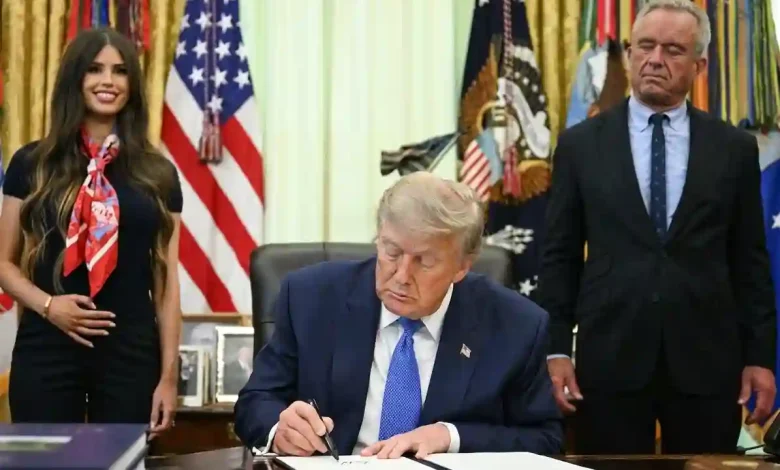
Table of Contents
Childhood vaccinations have emerged as the central battleground of a massive administrative and political conflict following a sweeping federal intervention. In a move that has sent shockwaves through the medical community and the halls of Congress, President Donald Trump signed an executive order earlier this month designed to significantly roll back the federal government’s long-standing pediatric immunization guidelines. The executive order, titled “Delivering Gold Standard Childhood Vaccine Recommendations for Americans,” seeks to slash the number of universally recommended vaccines from 18 down to 11. Crucially, the order also recommends unbundling the trivalent measles, mumps, and rubella (MMR) vaccine into three separate inoculations administered over multiple clinic visits.
Behind closed doors, however, the narrative is far more complicated than a simple policy overhaul. Five current and former administration officials privately disclosed to Reuters that the newly signed executive order alone does not substantially alter actual U.S. vaccine policy. Because state governments—rather than federal agencies—maintain the legal authority to set school vaccination mandates, these officials argue that the president’s administrative action will fail to satisfy either Trump’s personal demands or the highly mobilized, skeptical political base led by Health and Human Services (HHS) Secretary Robert F. Kennedy Jr.
The Genesis of the Executive Order
The catalyst for this executive order lies in President Trump’s long-standing personal skepticism regarding current pediatric protocols. According to administrative insiders, the president has grown increasingly frustrated by what he perceives as a lack of urgency within federal agencies to investigate a potential link between immunizations and autism. Despite exhaustive scientific consensus refuting any such connection, Trump’s persistent focus on the issue reached a boiling point this month, culminating in the unilateral directive.
Flanked by Health Secretary Robert F. Kennedy Jr. and National Institutes of Health (NIH) Director Dr. Jay Bhattacharya, Trump signed the order to fulfill a core campaign promise made to the “Make America Healthy Again” (MAHA) movement. White House spokesman Kush Desai defended the president’s aggressive posture, stating that Trump is actively responding to “countless parents who have had their questions and concerns about America’s childhood vaccine schedule ignored if not outright mocked.” These executive maneuvers mirror wider patterns observed in Trump’s administration tactics, wherein unilateral executive actions are utilized to bypass legislative stalemates and appease core constituencies.
Deconstructing the Policy Shift: Fewer Doses and Split MMR Shots
The core of the executive order relies on a comparative scientific assessment completed by the Department of Health and Human Services. The administration argues that the United States currently recommends more childhood immunizations than many peer European nations, which reportedly maintain high public trust without relying on extensive federal recommendations. By aligning the federal schedule with what the administration terms “international consensus,” the order strips away official recommendations for several highly common vaccines.
Specifically, the new guidelines withdraw federal support for childhood immunizations against six major diseases: Hepatitis A, Hepatitis B, rotavirus, meningitis, influenza, and COVID-19. Furthermore, the directive targets the trivalent MMR vaccine, suggesting that separating the components into individual, spaced-out injections will prevent hypothetical, unverified adverse reactions. The clinical and procedural distinctions between the old and new guidelines are outlined in the comparative table below.
| Vaccine / Protocol | Previous Guidelines (Pre-August 2026) | New Executive Order Guidelines | Primary Public Health Impact / Status |
|---|---|---|---|
| MMR (Measles, Mumps, Rubella) | Single combination injection (3-in-1) | Three separate, spaced-out single-antigen shots | Increased doctor visits, shortage of single-antigen vaccines |
| Hepatitis B | Universally recommended for infants | Removed from federal recommendation schedule | Requires states to set independent recommendations |
| COVID-19 & Influenza | Annually recommended for pediatric populations | Removed from federal recommendation schedule | Likely to reduce immunization rates in public schools |
| Rotavirus & Hepatitis A | Standard pediatric recommendation | Removed from federal recommendation schedule | Increased exposure risk to gastrointestinal and liver infections |
| Remaining Doses (e.g., Polio, DTaP) | 18 standard recommended childhood immunizations | Cut back to 11 “gold-standard” immunizations | Aligns federal guidelines with selected European models |
Administrative Friction: Why Officials Say the Order Falls Short
While the executive order represents a dramatic symbolic victory for the administration, federal officials admit that its practical reach is severely limited. Under the Tenth Amendment of the U.S. Constitution, individual states hold the sovereign “police power” to regulate public health, which includes setting the specific vaccination requirements children must meet to attend local public schools or daycare facilities. A federal executive order cannot legally override these state statutes.
As a result, five current and former officials have acknowledged that this executive order will not immediately dismantle the nationwide immunization infrastructure. This reality leaves the administration in a bind: the executive order will not satisfy the immediate demands of President Trump, who desires sweeping national changes, nor will it fully pacify the MAHA base, which views the order as an incomplete half-measure. While foreign policy is dominated by Trump’s economic war with rival nations, internal domestic battles over federalism and state healthcare control are proving equally combative, distracting the executive branch from executing critical foreign directives, such as U.S. economic sanctions aimed at external adversaries.
The MAHA Strategy: Beyond Unilateral Orders
Recognizing the legal and structural limitations of executive decrees, HHS Secretary Robert F. Kennedy Jr. and his allies are pivoting toward a more systemic, long-term strategy. Rather than relying solely on White House directives, the MAHA movement is focusing on a series of comprehensive, federally funded clinical studies initiated by the health secretary last year. These studies are designed to re-examine the safety profiles of standard immunizations and investigate the root causes of the nation’s chronic disease epidemics.
Del Bigtree, a prominent ally of Kennedy and chief executive officer of the Informed Consent Action Network, emphasized that unilateral administrative policy changes are vulnerable to judicial challenges and future political transitions. “No one wants to see this get done with an executive order. Robert F. Kennedy Jr. knows that will not be a lasting change if it’s not backed up by credible science,” Bigtree noted, adding that “this is only the beginning of a process that had to happen.” HHS spokeswoman Grace Davis Jamison confirmed that the agency is currently pursuing dozens of analytical projects using some of the nation’s largest health datasets to explore these controversial avenues.
Logistical and Financial Hurdles for Parents and Providers
Public health experts and pediatricians have sounded the alarm over the immense logistical and financial chaos the executive order is poised to trigger. Chief among these concerns is the recommendation to split the MMR vaccine. Currently, single-antigen vaccines for measles, mumps, and rubella are not widely manufactured or distributed in the United States, having been phased out decades ago in favor of the highly efficient, combined trivalent formulation. Forcing a return to separate shots would require pharmaceutical manufacturers to construct entirely new production pipelines.
For parents, the logistical burden is equally daunting. Spacing out these immunizations would require families to schedule, fund, and attend multiple separate medical appointments, placing an unsustainable strain on working-class households. This shift in recommended schedules will naturally introduce massive administrative hurdles for U.S. employer healthcare plans, as insurance providers struggle to categorize these newly un-recommended procedures. Pediatric clinics, already facing staffing shortages, would also have to manage a surge in routine visits and absorb the overhead costs of extra syringes, clinical space, and administrative filing.
Scientific Consensus vs. Political Narratives
The medical establishment has been swift and uncompromising in its condemnation of the White House’s new directive. Leading scientific institutions, including the Centers for Disease Control and Prevention (CDC), the American Academy of Pediatrics (AAP), and the World Health Organization (WHO), maintain that there is absolutely no credible scientific evidence linking routine childhood immunizations to autism or other neurodevelopmental disorders. Decades of peer-reviewed, global studies involving millions of children have consistently proven the safety and efficacy of combined vaccines.
Democratic governors, including J.B. Pritzker of Illinois and Josh Shapiro of Pennsylvania, have publicly condemned the executive order, warning that it will trigger a resurgence of entirely preventable, highly contagious diseases. “Measles are already on the rise in our country, and they want to continue to spread dangerous misinformation instead,” Pritzker stated on social media. Critics compare this federal dietary-and-health push to California’s food safety regulations, where localized standards created a fragmented national landscape for chemical and food additives, ultimately confusing consumers and complicating compliance.
Broader Domestic and Economic Implications
The political polarization of public health has deepened existing societal divides, eroding trust in scientific institutions. This distrust of clinical institutions echoes the public outrage surrounding the landmark J&J talc lawsuit, which similarly spotlighted deep-seated consumer anxieties about corporate science, regulatory capture, and consumer safety. By validating these anxieties at the executive level, the administration risks permanently damaging the public’s confidence in routine medical advice.
Politically, the executive order is a double-edged sword for the president’s legislative agenda. Just as political mobilization in blue-collar strongholds like Kingsport fuels Trump’s populist platform, the MAHA base leverages medical skepticism to secure structural concessions. However, political strategists warn that the executive branch may be stretching its political capital thin, particularly as consumers remain aggravated by surging fuel prices and high grocery bills. Attempting to enforce a federal retrenchment of public health guidelines could alienate moderate suburban voters who rely heavily on stable, predictable public school requirements.
Conclusion
Ultimately, President Trump’s executive order on childhood immunization recommendations exposes a deep philosophical chasm within modern American governance. While designed to appease a vocal, skeptical political base and fulfill personal theories regarding autism, the actual policy-making power remains firmly in the hands of state governments and independent school boards. As the Department of Health and Human Services embarks on controversial new health safety studies under Secretary Kennedy, the administrative, logistical, and legal battles surrounding pediatric medicine are only just beginning, leaving parents, doctors, and manufacturers to navigate a highly fractured public health landscape.