Donald Trump: 47th President of the United States (2026 Profile)
Executive Insights
- Donald Trump is the 47th U.S. President, serving a historic non-consecutive second term (2025-2029).
- He won the 2024 election with a decisive 312 electoral votes and the popular vote.
- The 2025 agenda focused on mass deregulation, border security emergencies, and trade tariffs.
- Federal legal cases against him were dismissed following his election victory.
- The Department of Government Efficiency (DOGE) was established to overhaul the federal workforce.
Donald John Trump (born June 14, 1946) is the 47th and current President of the United States, having assumed office on January 20, 2025. A member of the Republican Party, Trump previously served as the 45th president from 2017 to 2021. His victory in the 2024 presidential election marked a historic political comeback, making him only the second president in U.S. history, after Grover Cleveland, to serve two non-consecutive terms.
As of January 2026, President Trump’s second administration is characterized by an aggressive implementation of the “America First” agenda, utilizing a record number of executive orders to reshape federal bureaucracy, immigration policy, and international trade relations. This profile examines his 2024 electoral victory, the legislative and executive actions of his first year in office (2025), and the current status of his legal and political standing.
The Historic 2024 Election Victory
On November 5, 2024, Donald Trump defeated the incumbent Vice President Kamala Harris in a decisive victory that realigned the American political map. Unlike his 2016 victory, Trump secured both the Electoral College and the popular vote, signaling a broader mandate for his policies.
Electoral College Breakdown
Trump secured 312 electoral votes compared to Harris’s 226, surpassing the 270 threshold needed to win. The victory was cemented by sweeping all seven critical swing states:
| Swing State | Winner | Significance |
|---|---|---|
| Pennsylvania | Trump (R) | Key Rust Belt victory; 19 electoral votes. |
| Georgia | Trump (R) | Flipped back to GOP after 2020 loss. |
| Michigan | Trump (R) | Reclaimed “Blue Wall” state. |
| Wisconsin | Trump (R) | Narrow victory cementing Midwest dominance. |
| Arizona | Trump (R) | Strong performance on immigration issues. |
| Nevada | Trump (R) | First GOP presidential win in the state since 2004. |
| North Carolina | Trump (R) | Held despite strong Democratic campaigning. |
In addition to the presidency, the Republican Party regained control of the U.S. Senate (53-47) and maintained a narrow majority in the House of Representatives, granting the administration a government trifecta to begin the term.
Second Term Agenda: The First Year (2025-2026)
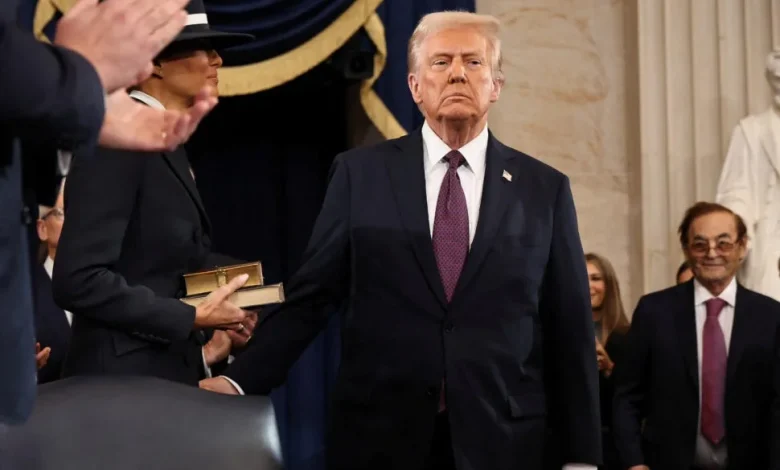
Upon his inauguration on January 20, 2025, President Trump launched an unprecedented blitz of executive actions. In his first year alone, he signed over 225 executive orders, surpassing the first-year records of all modern presidents. The administration’s focus has been defined by radical deregulation, strict immigration enforcement, and a restructuring of the federal workforce.
Key Executive Actions and Policies
- Department of Government Efficiency (DOGE): Established in January 2025, this advisory body—briefly led by Elon Musk—was tasked with dismantling government bureaucracy. It oversaw the reclassification of thousands of civil service roles (Schedule F), leading to significant workforce reductions across federal agencies.
- Immigration and Border Security: Declaring a “National Emergency” at the southern border on Day 1, Trump reinstated the “Remain in Mexico” policy and initiated mass deportation protocols. Controversial attempts to challenge birthright citizenship via executive order are currently tied up in federal litigation.
- Energy Dominance: The administration withdrew the United States from the Paris Agreement for a second time and expedited permits for oil and gas drilling, particularly in Alaska (ANWR), under the mantra “Drill, Baby, Drill.”
- Trade and Tariffs: 2025 saw the implementation of a universal baseline tariff on most imports, with specific reciprocal tariffs targeting China and the European Union, aiming to reduce the trade deficit and incentivize domestic manufacturing.
- Social Policy: Executive orders were issued to ban diversity, equity, and inclusion (DEI) programs within the federal government and to roll back protections for transgender individuals in education and healthcare.
Legal Status and Immunity
The return to the White House fundamentally altered the trajectory of the multiple criminal cases facing Donald Trump. As a sitting president, he benefits from Department of Justice (DOJ) policies against prosecution.
- Federal Election Interference Case (Jan 6): Special Counsel Jack Smith moved to dismiss the case in November 2024, citing DOJ policy. Judge Tanya Chutkan formally dismissed the charges on November 25, 2024.
- Classified Documents Case: Similarly dismissed, ending the federal pursuit of charges regarding the retention of national defense information at Mar-a-Lago.
- New York “Hush Money” Conviction: Despite being convicted on 34 felony counts in May 2024, Trump has not faced sentencing. His legal team successfully argued for indefinite delays citing presidential duties and the Supreme Court’s Trump v. United States immunity ruling.
- Georgia RICO Case: The state-level election interference case has been effectively frozen, with proceedings stayed until the conclusion of his presidential term in 2029.
Cabinet and Key Appointments
President Trump’s second-term cabinet reflects a preference for loyalty and ideological alignment. Vice President JD Vance has played a central role in legislative negotiation and foreign policy advisory.
Notable Appointments (2025-2026):
- Secretary of State: Focused on an “America First” diplomatic approach, renegotiating alliances and questioning funding for international bodies like the WHO.
- Attorney General: Prioritized the dismantling of what the administration terms the “weaponization of government,” focusing investigations on internal DOJ leaks and prior prosecutorial conduct.
Economic Impact and Legacy
By early 2026, the economic landscape reflects the administration’s aggressive protectionism. While domestic energy production has hit record highs, the imposition of tariffs has led to inflationary pressure in certain consumer goods sectors. The stock market has remained volatile, reacting to the rapid pace of deregulation against the backdrop of trade wars.
Donald Trump’s legacy is increasingly defined by his transformation of the Republican Party into a populist, nationalist movement and his reshaping of the American judiciary and federal civil service. His second term seeks to institutionalize these changes, aiming to leave an indelible mark on the structure of the U.S. government.
In-Depth Q&A
Q: Did Donald Trump win the 2024 presidential election?
Yes, Donald Trump won the 2024 election, defeating Kamala Harris with 312 electoral votes to her 226 and securing the popular vote.
Q: What is the Department of Government Efficiency (DOGE)?
DOGE is a government restructuring initiative launched by President Trump in January 2025, tasked with cutting federal spending and bureaucracy. It was briefly led by Elon Musk.
Q: What happened to Donald Trump’s legal cases after he won in 2024?
Federal cases regarding election interference and classified documents were dismissed by the DOJ due to policies against prosecuting a sitting president. His New York state conviction sentencing was indefinitely postponed.
Q: Who is Donald Trump’s Vice President in his second term?
JD Vance serves as the 50th Vice President of the United States, inaugurated alongside President Trump on January 20, 2025.
Q: How many executive orders did Trump sign in 2025?
President Trump signed over 225 executive orders in 2025, setting a record for the most executive actions in a single year by a modern president.



8 Comments